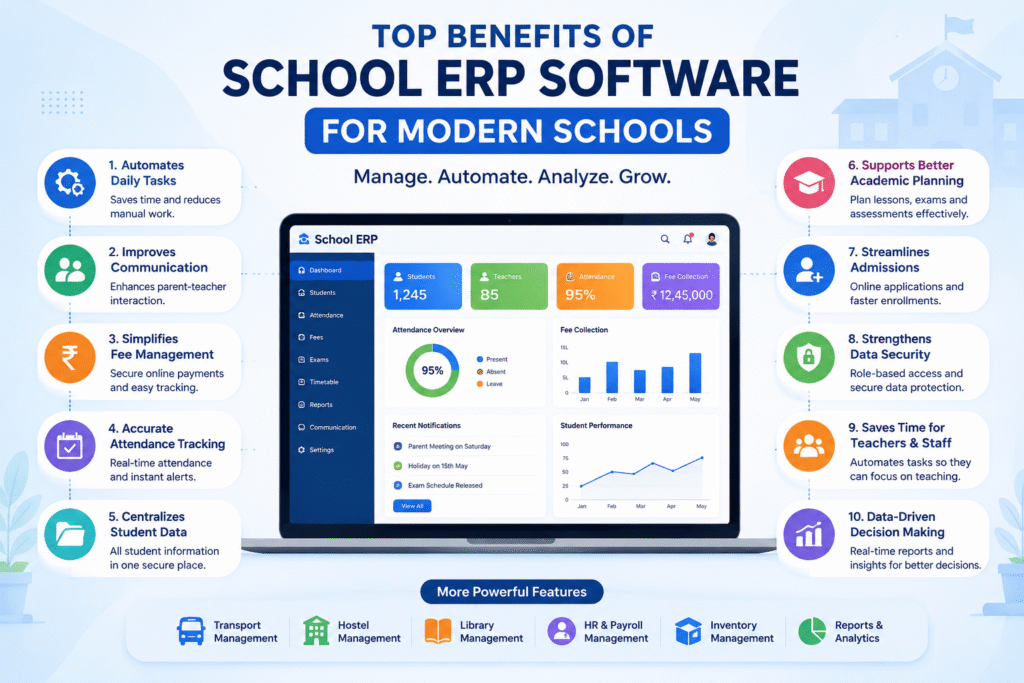
School ERP software helps modern schools manage daily operations from one digital platform. It automates tasks such as attendance, fee collection, admissions, timetable management, exam records, parent communication, transport tracking, payroll, and student data management.
For schools, the biggest benefits of school ERP software are better efficiency, improved communication, fewer manual errors, stronger data security, faster decision-making, and a smoother experience for students, parents, teachers, and administrators.
In simple terms, school ERP software turns manual school management into a connected, automated, and data-driven system.
What Is School ERP Software?
School ERP software is a digital school management system that helps educational institutions manage academic, administrative, financial, and communication activities from a single platform.
ERP stands for Enterprise Resource Planning. In schools, ERP software connects different departments such as admissions, accounts, academics, transport, library, hostel, HR, and administration.
Instead of using separate registers, spreadsheets, WhatsApp groups, paper forms, and manual reports, schools can use one centralized system to manage important tasks.
A modern school ERP system usually includes:
- Student information management
- Attendance management
- Fee collection and payment tracking
- Online admission management
- Parent-teacher communication
- Timetable scheduling
- Exam and result management
- Transport tracking
- Library management
- HR and payroll management
- Inventory and asset management
- Reports and analytics
- Mobile app access for parents, teachers, and students
Why Modern Schools Need ERP Software
Modern schools are no longer managed only through classrooms, registers, and notice boards. Schools today need to handle large amounts of data, communicate quickly with parents, track student performance, manage digital payments, follow compliance requirements, and provide better transparency.
Digital transformation in education is also becoming a major global priority. UNESCO supports the development of digital learning policies that improve access, manage risks, and encourage innovation in education. OECD also recognizes digital technologies as important drivers of innovation in school management, teaching, and learning, while noting the need to manage issues such as equity and interoperability.
This is where school ERP software becomes valuable. It helps schools reduce manual workload, improve accuracy, and create a better experience for all stakeholders.
Top Benefits of School ERP Software
1. Automates Daily School Administration
One of the biggest benefits of school ERP software is automation. Schools handle many repetitive tasks every day, such as marking attendance, sending notices, collecting fees, preparing reports, updating student records, and managing staff data.
A school ERP system automates these tasks and reduces manual effort.
Examples of administrative automation:
- Automatic attendance reports
- Fee reminders to parents
- Digital report card generation
- Online admission form processing
- Automated timetable creation
- Instant SMS, email, or app notifications
- Staff leave and payroll tracking
This saves time for administrators and reduces the chances of human error.
2. Improves Parent-Teacher Communication
Strong communication between parents and teachers is essential for student success. Traditional communication methods, such as paper notices, phone calls, and informal messages, are often slow or inconsistent.
School ERP software provides a structured communication platform where parents can receive real-time updates.
Parents can get updates about:
- Attendance
- Homework
- Exam schedules
- Results
- Fee dues
- School announcements
- Events
- Transport status
- Teacher remarks
This improves transparency and builds trust between schools and families.
For example, if a student is absent, the school ERP system can automatically notify the parent through SMS, email, or mobile app notification.
3. Simplifies Fee Management
Fee collection is one of the most important administrative tasks for any school. Manual fee management can lead to delayed payments, calculation errors, duplicate entries, and time-consuming follow-ups.
A school fee management software module helps schools manage fees digitally.
Key fee management benefits:
- Online fee payment
- Automatic receipt generation
- Fee due reminders
- Installment tracking
- Late fee calculation
- Scholarship and discount management
- Class-wise and student-wise fee reports
- Payment history records
This helps the finance team reduce paperwork and gives parents a convenient way to pay fees online.
4. Makes Attendance Tracking Faster
Manual attendance tracking takes time and can be inaccurate. Teachers may need to mark attendance in registers and then submit reports separately to the office.
With school ERP software, attendance can be marked digitally in seconds.
Attendance management benefits:
- Daily attendance tracking
- Subject-wise attendance
- Biometric or RFID integration
- Automatic absence alerts
- Monthly attendance reports
- Student attendance history
- Staff attendance tracking
This helps schools monitor student regularity and quickly identify attendance issues.
5. Centralizes Student Data
Every school manages large amounts of student information, including admission details, academic records, attendance, health information, fee history, documents, exam results, and parent contact details.
Without a centralized system, this data often gets scattered across registers, spreadsheets, files, and different departments.
A school ERP system stores student data in one secure place.
Centralized student data may include:
- Personal details
- Parent and guardian information
- Academic history
- Attendance records
- Fee records
- Examination results
- Certificates and documents
- Medical details
- Disciplinary records
- Transport details
This makes it easier for school staff to access accurate information whenever needed.
6. Supports Better Academic Planning
School ERP software is not only useful for administration. It also supports academic planning and performance tracking.
Teachers and academic coordinators can use ERP tools to manage lesson plans, assignments, exams, grading, and student progress.
Academic benefits include:
- Lesson planning
- Homework assignment
- Online test management
- Exam scheduling
- Marks entry
- Report card generation
- Student performance analysis
- Subject-wise progress tracking
This helps teachers identify students who need extra support and helps academic heads make better decisions.
7. Improves Admission Management
Admissions can be complex, especially during peak admission seasons. Schools need to manage inquiries, application forms, document verification, entrance tests, interviews, fee payments, and enrollment records.
Online admission software within a school ERP system simplifies this process.
Admission management benefits:
- Online inquiry forms
- Digital application forms
- Document upload
- Application status tracking
- Admission test scheduling
- Merit list management
- Fee payment integration
- Automatic student profile creation
This creates a smoother experience for parents and reduces the burden on admission teams.
8. Strengthens Data Security
Schools manage sensitive data, including student records, parent contact details, financial information, staff details, and academic performance data. Protecting this information is extremely important.
A good school ERP software provides role-based access, secure login, data backup, and permission controls.
Important security features:
- Role-based access control
- Password-protected login
- Data encryption
- Cloud backup
- User activity tracking
- Permission-based modules
- Secure payment integration
Data privacy is especially important in education because children’s information must be handled carefully. UNESCO has highlighted concerns around digitalization, including privacy, protection, digital divide, and learner wellbeing.
9. Saves Time for Teachers and Staff
Teachers often spend a lot of time on non-teaching work such as attendance, marks entry, report cards, homework tracking, and parent updates.
School ERP software reduces this workload.
Teachers can save time on:
- Attendance marking
- Assignment sharing
- Exam result entry
- Report card preparation
- Parent communication
- Lesson planning
- Student performance tracking
This allows teachers to focus more on teaching, mentoring, and improving student outcomes.
10. Helps School Leaders Make Data-Driven Decisions
School leaders need accurate data to make informed decisions. Without proper reports, it becomes difficult to understand what is working and what needs improvement.
School ERP software provides real-time reports and dashboards.
Useful reports for school leaders:
- Student attendance reports
- Fee collection reports
- Admission reports
- Academic performance reports
- Staff attendance reports
- Transport reports
- Expense reports
- Class-wise performance reports
- Parent engagement reports
For example, if attendance is low in a particular class, the principal can quickly identify the issue and take action.
11. Improves Transport, Hostel, and Inventory Management
Many schools also manage transport, hostel facilities, uniforms, books, assets, labs, and inventory. Managing all these manually can be difficult.
A school ERP system can include modules for transport, hostel, library, and inventory management.
Transport management features:
- Route planning
- Vehicle details
- Driver records
- GPS tracking
- Student pickup and drop details
- Transport fee management
Hostel management features:
- Room allocation
- Student records
- Visitor management
- Hostel fee tracking
- Meal and facility records
Inventory management features:
- Asset tracking
- Stock records
- Purchase entries
- Issue and return records
- Maintenance tracking
This helps schools manage resources more efficiently.
12. Supports Scalability for Growing Schools
As a school grows, manual systems become harder to manage. More students, more staff, more departments, and more branches create more complexity.
School ERP software supports scalability by allowing schools to manage growth without losing control.